Codex and the new Pro plans: better models, lower limits for USD 200
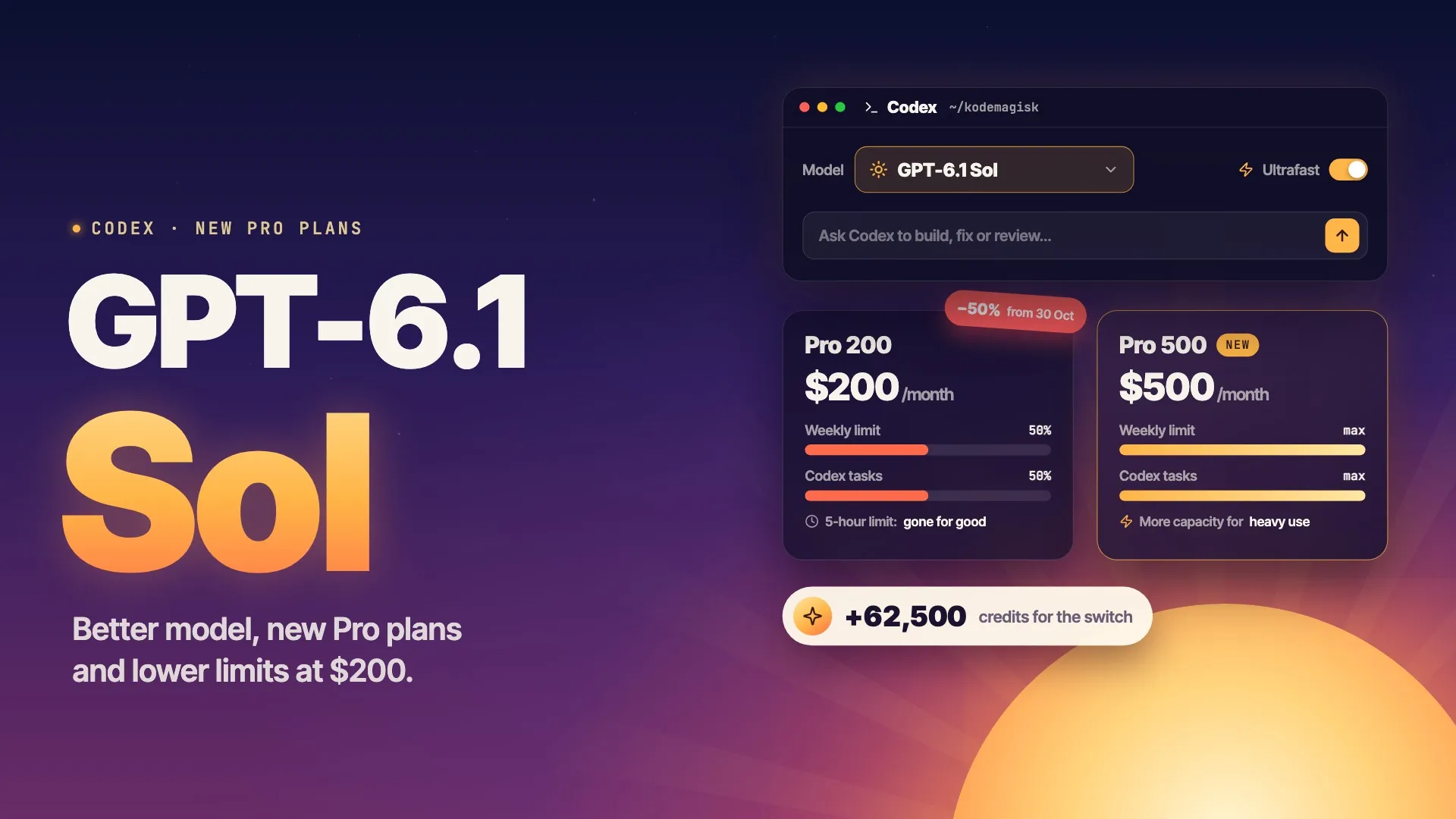
OpenAI has introduced GPT-6.1 Sol and the new Pro 500 subscription, two important additions for people who use Codex and ChatGPT Work professionally. The launch also brings a less welcome change for some existing subscribers: Pro 200 keeps its price of USD 200 per month while reducing two of the limits communicated to customers.
From 30 October 2026, the ChatGPT Work and Codex allowance announced to affected Pro 200 subscribers falls from 20 times to 10 times the Plus level. In Chat, the GPT-6 Pro limit drops from 200 to 100 messages per week. Both reductions are 50%. A more capable model can change how much work you get done, but the reduction in these allowances remains a concrete change to the subscription.
GPT-6.1 Sol: a new model for everyday work
Introduced on 29 September, GPT-6.1 Sol is positioned by OpenAI as a model offering performance close to GPT-6 Astra for complex coding, computer use and professional work, at a lower cost. Its rollout in ChatGPT Work and Codex starts with Pro users and expands to other eligible plans.
The promise is relevant to developers: fewer rounds of revisiting the same problem, a better understanding of requirements and the ability to make progress on tasks that challenged the previous version. An agent that reaches a correct solution sooner can save both time and usage. These benefits still depend on the task; approaching Astra's performance does not mean identical results on every project.
Codex continues to expand beyond the editor
The announcements also include Codex Cloud, where coding tasks can be started or continued from desktop, web or mobile. Each task has its own isolated workspace and can continue even while the user's computer is asleep.
The direction is clear: agents are taking on work that can last longer than an ordinary conversation. This makes usage limits an important part of the offering for people who work with these tools every day.
What changes for Pro 200, and when?
For eligible existing subscribers who keep their subscription active, the previous allowances remain valid through 29 October 2026, inclusive. The reduced amounts apply from 30 October. New Pro 200 subscriptions that do not qualify for this transition period already start with a lower allowance.
| Pro 200 | Through 29 October 2026, for eligible subscribers | From 30 October 2026 |
|---|---|---|
| Announced monthly price | USD 200 | USD 200 |
| ChatGPT Work and Codex allowance, relative to Plus | 20× | 10× |
| GPT-6 Pro in Chat | 200 messages per week | 100 messages per week |
This comparison covers the limits specified in the notice sent to affected subscribers. The reduction in GPT-6 Pro messages applies to that model in Chat. The Work and Codex allowance is a usage limit, with consumption depending on the model, task complexity and way of working.
We can therefore say that the two announced allowances are being halved. We cannot automatically conclude that every user will complete exactly half as many projects as before. Work completed and available allowance are different measures.
The five-hour limit is not coming back
OpenAI is maintaining its commitment to Pro 200 subscribers not to reintroduce the five-hour limit. Users can concentrate their weekly allowance on the periods when they need to work more intensively.
This flexibility remains useful for a day dedicated to a project or when a delivery deadline is approaching. It does, however, coexist with a smaller weekly allowance. Being able to use the budget when you need it does not change the size of that budget.
62,500 transition credits, with an expiry date
The transition notice announces a one-time grant of 62,500 usage credits, valued by OpenAI at USD 2,500. The bonus is intended for eligible subscribers covered by the offer and expires on 31 December 2026.
For supported features, the usage included in the subscription is consumed first, followed by the credit balance. These credits can support additional work in Codex and ChatGPT Work. They are usage credits, separate from API billing, and their value does not represent a cash refund to the subscriber.
The bonus could make a difference for people with substantial projects over the coming months. Its effect is temporary, however: the reduced subscription allowance continues to apply once the credits are used up or expire. The transition offer and the subscription's long-term value therefore need to be assessed separately.
Pro 500: more capacity for USD 500 per month
The new Pro 500 subscription expands the Pro range with its highest level of included usage. The announced price is USD 500 per month, and the communicated Work and Codex allowance is 25 times the Plus level. The plan also includes access to Astra Ultrafast.
| Feature | Pro 200 with the new allowances | Pro 500 |
|---|---|---|
| Announced monthly price | USD 200 | USD 500 |
| Work and Codex allowance, relative to Plus | 10× | 25× |
| Astra Ultrafast | Not included | Included |
Compared with the new Pro 200, Pro 500 costs 2.5 times as much and offers an allowance multiplier that is 2.5 times as large. These two figures alone do not show an additional price advantage per unit of allowance. The difference includes access to Ultrafast and a larger overall budget.
For a subscriber comparing the new Pro 500 with their previous Pro 200 allowance, the picture is different: the multiplier rises from 20× to 25×, an increase of 25%, while the price rises from USD 200 to USD 500, an increase of 150%. This is an arithmetic comparison of the announced prices and allowances, without equating model performance or other benefits.
Ultrafast: extra speed consumes more usage
Astra Ultrafast can generate tokens up to eight times faster than Astra in Standard mode in Codex. This measures generation speed, rather than the total time needed to complete a project. Running tests, accessing services and other operations can still account for part of the working time.
There is also a usage cost: Ultrafast consumes the included allowance at eight times the Standard rate for the same model. When credits are used, the rate is six times Standard. Access to this mode through Pro 500 therefore comes with higher usage consumption. At launch, buying credits on Pro 100 or Pro 200 does not unlock Ultrafast.
Is this a fair change for existing subscribers?
OpenAI explains the decision through the evolution of its models: better capabilities and greater efficiency should enable more work to be completed. That argument deserves consideration. A good result achieved in fewer attempts can be worth more than a large number of responses that need correcting.
In our view, however, a better model is not enough to present reduced allowances as a benefit for every customer. Someone already paying USD 200 per month and making heavy use of the included budget loses some of the working capacity they previously had available. For these users, the change is harder to accept, even if the new model is more capable.
The transition period, credit bonus and continued weekly flexibility are concrete benefits. They soften the immediate impact. At the same time, a stable offering matters to professionals who organise their work and expenses around a subscription.
We believe subscribers' concerns are justified. The value of the new arrangement will depend on results in practice, and the promise of more efficient models does not by itself demonstrate that every customer will fully recover the difference in allowance.
What this launch means for developers
GPT-6.1 Sol and Ultrafast show two important directions in the evolution of Codex: increasingly capable models for everyday work and additional speed options for intensive use. Meanwhile, differences between subscriptions are becoming more important to the cost and continuity of that work.
At Kodemagisk, we follow these changes through the lens of web development, applications and SaaS projects. We care about how well a model helps people understand a project, solve problems and build useful features. Predictable access to those capabilities matters just as much.
For Pro 200, the key date remains 30 October 2026. Until then, eligible existing subscribers retain their previous allowances. After that date, the new model and the reduced allowances will need to be judged together in everyday work.