From chatbot to digital organisation: Grok Bot Galaxy shows how fast AI is evolving
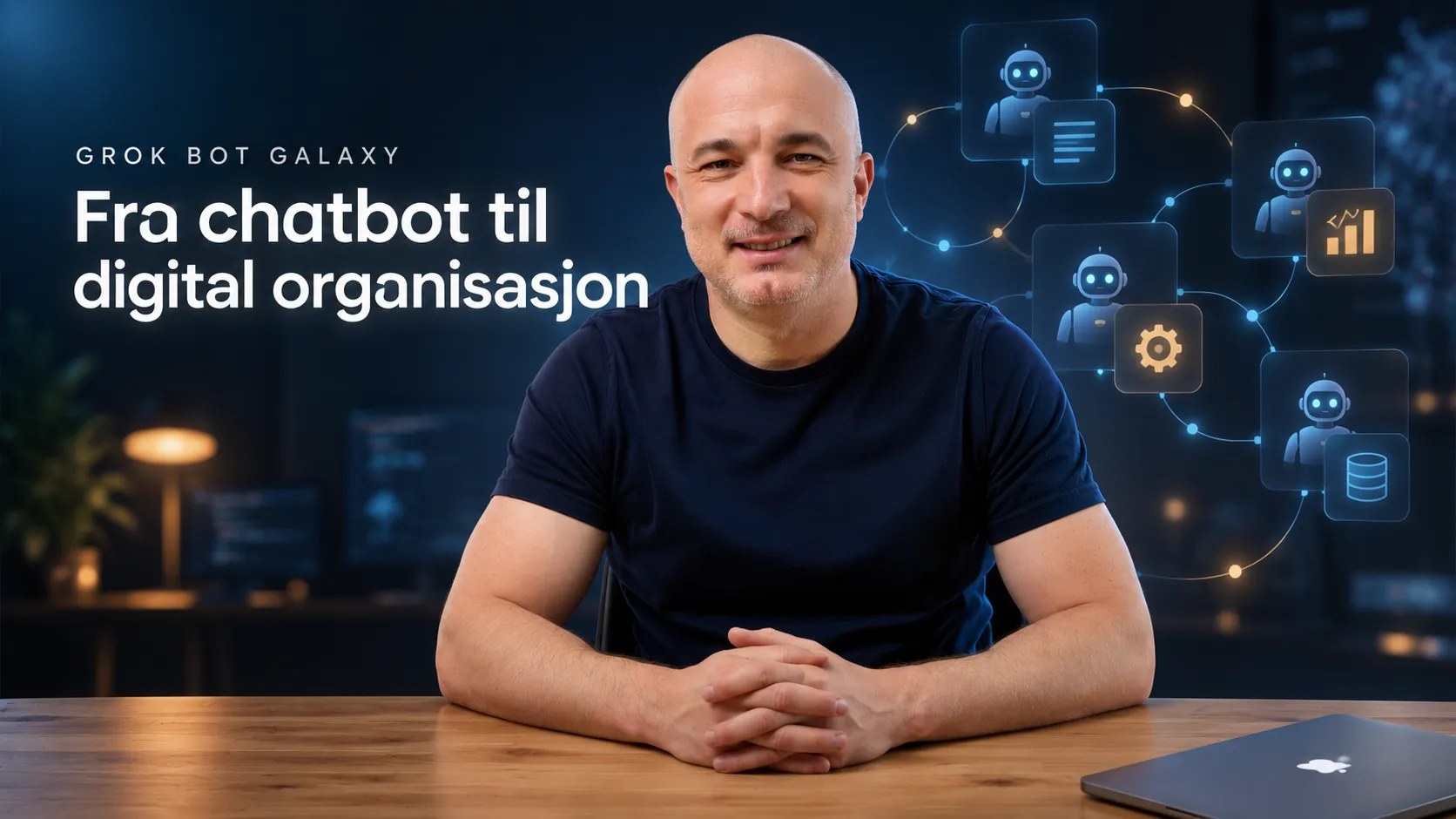
Over the past two days, I followed a live demonstration that made artificial intelligence far more tangible than the usual promises about “the technology of the future”. It was about more than asking a chatbot questions. We watched AI agents take on roles, use tools, divide tasks and work together as a small digital team.
The most interesting part was not the automation of a single task. It was seeing several agents brought together in a structure that resembled a business: one did the work, another analysed the results, and a third kept an eye on the bigger picture.
What is Grok Bot Galaxy?
Grok Bot Galaxy was a live demonstration by xAI, held on 15–17 September 2026 in San Francisco. According to xAI’s introduction to Grok Bot, Matt Palmer, Lauren Tan and Roshan Sadanani were to attempt to build a business from scratch in three days, with Grok-based agents as their workforce.
The starting point was simple: no established organisation, no lengthy project plan and no large staff. Just three people, a group of digital agents and the question of how much could actually be built when AI could not only provide answers, but also carry out and coordinate work.
A simple coffee survey revealed something much bigger
One of the first demonstrations was almost an everyday task. An agent was asked to create a short survey in Google Forms: Which café in town do you like best? What kind of coffee flavour do you prefer? Within moments, the form was created and ready to use.
Then came the next layer. Another agent was put in charge of collecting and interpreting the responses. A third acted as a kind of chief of staff, coordinating the others’ work. Suddenly, this was no longer a demonstration of a form, but a small organisation with a division of labour, information flow and leadership.
That is precisely what made the demonstration so interesting: the task was simple enough for anyone to understand, but the structure behind it could scale much further, into customer service, market research, sales, administration, content creation or product development.
From one assistant to a team of digital colleagues
We are used to thinking of AI as a single conversation partner. We open a window, type a request and wait for an answer. Agent-based systems push that boundary. Instead of one general assistant, we can create specialised roles:
- a research agent that gathers and compares information
- a content agent that drafts text, images or campaigns
- a sales agent that follows up on leads and updates systems
- a support agent that sorts and responds to customer enquiries
- an administrative agent that creates forms, reports and tasks
- a development agent that writes, tests and improves code
- a coordinator that assigns work and monitors progress
The difference matters. A chatbot helps you at a particular moment. An agent system can work through an entire process, use several tools and pass the result on to the next role.
Can three people build a business in three days?
That was exactly what the team tried to answer during the livestream. They started with an almost blank slate and let the agents contribute to the direction, name, workspace setup, division of roles, design, landing page and practical details of a new service. The idea evolved towards a platform for pop-up restaurants.
This does not mean that a complete, mature business can be conjured up in a few hours. Strategy, legal responsibility, finances, quality, customer relationships and difficult decisions still require human judgement. But the demonstration showed how quickly the foundations can be built when coordination and production no longer have to start from scratch.
For an entrepreneur, this may be the biggest change: the distance between an idea and the first working version becomes shorter. One person can test more hypotheses, create more prototypes and automate more repetitive work before needing to build a large team.
How quickly has AI really developed?
Only a few years ago, generative AI was impressive mainly because it could write coherent text or create an image from a description. Now we are seeing another shift:
- from answering to acting
- from one model to several collaborating agents
- from isolated tasks to connected workflows
- from suggestions to actually using tools
- from a personal assistant to a form of digital organisation
This development is not perfect. Agents can misunderstand a goal, choose the wrong tool, produce incorrect information or continue in the wrong direction. The more autonomy they have, the more important clear boundaries, logging, approvals and human oversight become.
Even so, the direction is hard to ignore. The question is no longer just how well a model can formulate an answer. It is how reliably an entire system of models can plan, carry out, check and improve work.
Investment follows the development
When technology changes this quickly, money follows. The OECD has reported that AI companies received around $258.7 billion in venture capital in 2025, accounting for roughly 61 per cent of global venture capital that year.
This does not mean that literally “all the money” goes to a handful of AI giants. But it does reveal a clear concentration: investors, infrastructure, talent and attention are drawn towards companies building models, data centres, chips and platforms for artificial intelligence.
This creates a real risk that power will concentrate among those who can afford enormous investments in computing capacity and data. At the same time, their tools are becoming available to small businesses and individuals, who can use the same infrastructure to compete in entirely new ways. Both can be true at once.
Do we need to adapt?
Yes, but with a critical eye. Ignoring agent-based AI could prove costly, particularly in industries where competitors use the technology to work faster and more cheaply. But automation without oversight can be just as dangerous.
A responsible approach includes:
- clear goals and limited permissions for each agent
- human approval before payments, publishing or important decisions
- control over which data agents can access
- traceability: who did what, and on what basis
- ongoing quality checks and the ability to stop the process
We do not have to choose between enthusiasm and scepticism. The most realistic attitude is curious, practical and critical at the same time.
What does this mean for small and medium-sized businesses?
The best starting point is not to build an entire “digital business”. Choose one repeatable workflow that takes time and has a clear outcome. This could be:
- collecting customer feedback and producing a weekly summary
- preparing a newsletter from approved sources
- sorting enquiries and suggesting responses
- creating tasks from meetings and following up on deadlines
- researching the market and comparing competitors
Let the agent carry out a limited first step, measure the quality and keep a human responsible for approving the result. More responsibility should only be automated once the process is stable.
The business of the future will not necessarily be without people
Grok Bot Galaxy did not leave me with the impression that people are becoming irrelevant. On the contrary, the human role is becoming clearer: we need to define the goals, set the boundaries, choose the values that guide the work and take responsibility when something goes wrong.
What changes is how much work one person can set in motion. A small group can gain the capacity of a much larger team. Tasks that previously required many applications, suppliers and manual handovers can increasingly be brought together in one coordinated workflow.
That is why we should ask two questions at the same time: What can we build now that was previously beyond our reach? And what rules do we need to make what we build safe, fair and useful?
Whether we like the pace or not, the shift from chatbots to digital organisations is already underway. The wisest thing we can do is learn how these systems work before entrusting too much to them.