A developer cloned seven Adobe apps with Claude. “Software is over”?
At the end of September, a developer published seven apps on GitHub that imitate Adobe’s best-known programs: Photoshop, Illustrator, Premiere, Lightroom, After Effects, InDesign and Acrobat. They are free, open-source and built with the help of Claude, Anthropic’s AI model. The developer’s conclusion, perhaps a little overexcited: “Software is over.”
What is ArtCraft?
The project is called ArtCraft, and its creator is Brandon Thomas. The apps have names you can probably guess: PhotoCraft, VectorCraft, FilmCraft, LightCraft, EffectCraft, DesignCraft and PrintCraft. All are written from scratch in Rust, a modern programming language, have versions that run directly in the browser, and closely reproduce Adobe’s interfaces.
Thomas says he built them with Claude Opus 5.5 using a clean-room approach: recreating a program’s functionality without copying the original code. The method is not new. The BIOS implementations that paved the way for IBM-compatible PCs in the 1980s were developed the same way.
Why he did it
His stated reason: he was fed up with Adobe’s expensive subscriptions. I believe him.
An “annual, paid monthly” plan shows you a monthly price, but the commitment lasts a year. Under the US terms, cancelling after the first 14 days means paying a fee equal to 50% of the value of the remaining months. In 2024, the US Department of Justice, following a referral from the FTC, sued Adobe over allegations that it concealed this fee and put obstacles in the way of cancellation.
The hype and the reality
Look closely and the apps still have serious gaps. Their creator calls them “super early alpha.” PhotoCraft, the Photoshop clone, has all 625 menu commands wired up to something functional, but its own banner warns that it is not ready for everyday professional work. Early testers have already found plenty of missing pieces, and the promise of parity with Adobe quickly shifted from “in a month” to “months, not years.”
And yet PhotoCraft collected almost 7,000 GitHub stars in a single week. People are not applauding a finished product. They are applauding a possibility.
Adobe’s four moats
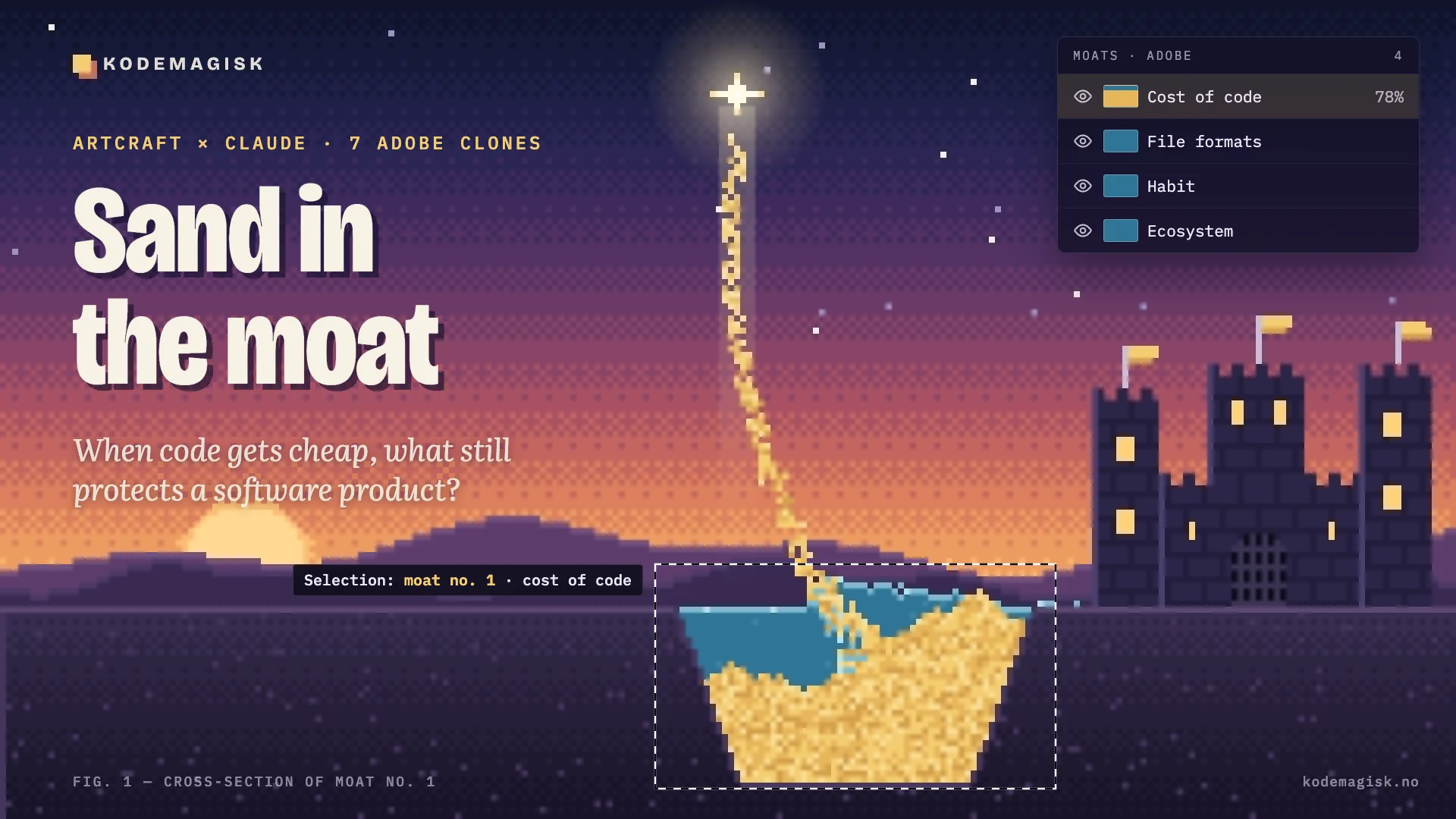
In business, a “moat” is the water-filled ditch around the castle: the advantage that protects you from competitors. Over more than 30 years, Adobe has dug four of them:
- The cost of writing the code. Decades of work by thousands of engineers. Before AI, the idea of rebuilding Photoshop on your own sounded crazy. Let alone another six apps alongside it.
- The file formats. PDF has long been an open standard, but a PSD with hundreds of layers, smart objects and effects, an AI file or an INDD file must open identically, down to the last pixel. Years of projects and files received from clients depend on it.
- Habit. A generation of Romanian designers learned Photoshop using a pirated installer downloaded from DC++ or torrents. The shortcuts stayed in their fingers, the reflexes in their heads. That does not change overnight.
- The ecosystem. Plugins, fonts, stock images, cloud services, collaboration and enterprise contracts with agencies. A whole world built around the apps.
AI is filling the first moat with sand. What once demanded hundreds of engineers and years of work can now be tackled by a handful of people in a few months, with experience and a hefty token bill. There is still a long road to the same reliability, but the cost of getting into the game has collapsed.
The other three moats are holding for now. But without the first one, they become targets. If the interface feels familiar, the PSD opens correctly and you can finish your work, the free version becomes very tempting.
Most people do not even use every Photoshop feature their subscription pays for. An alternative does not have to reproduce them all to be enough.
This is where the problem begins for any expensive subscription software: how much of the price pays for today’s value, and how much pays for the fact that, until yesterday, building an alternative was simply too difficult?
What it means for Romania
Of course, Adobe will not disappear next month. The ArtCraft clones could run into technical problems, compatibility issues or their first lawsuit: an almost identical interface is much trickier legal territory than code rewritten from scratch. And much of the enterprise software built in Romania has integrations and business rules that are far harder to reproduce than an interface.
But the question hits close to home in Romania. The IT and communications sector contributes around 6–7% of the country’s GDP, and a significant part of it involves writing code for other people’s products. As code gets cheaper, value shifts towards what is hard to copy: domain knowledge, client relationships, data and trust.
None of those comes with a lifetime guarantee either. As a company’s knowledge and processes enter AI tools, its advantage gets thinner. Where the same information is also used to train models, the pace accelerates.
“Software is over” is probably a premature conclusion. But the branch on which many companies sit comfortably has started to creak. The question for a software company is no longer “how well do we write code?” but “what do we know that a model does not know yet?”