Grok 4.7 and Gemini 3.8: New AI releases and the benchmarks behind them
You open your code project, choose an AI model and give it a task. But which model should handle a change that touches the database, business logic and tests? September has brought developers more options — and more numbers to interpret.
Grok 4.7 has arrived in Cursor. Google has released Gemini 3.8 Flash and new models for real-time conversations. Here we look at what has changed, how to read the benchmarks, and how to compare models on work that matters to you.
Updated 22 September 2026. This article draws on vendor documentation and published tests from Artificial Analysis. Kodemagisk has not conducted its own comparative product test.
Grok 4.7: a new candidate for demanding coding tasks
SpaceXAI released Grok 4.7 on 21 September. The company describes a larger base model and training focused on tasks that require sustained work and checking its own results.
In Cursor, the model is available on paid plans and draws from the Cursor Models allowance. You can choose low, medium, high or xhigh reasoning effort; high is the default. The documentation specifies a standard context window of 256,000 tokens and up to 500,000 with long context, with higher rates above 256,000 input tokens.
Cursor recommends Grok 4.7 for harder tasks that take longer, while Composer remains an option for routine work where speed and cost matter. That offers a useful starting point: try the new model on a demanding, clearly scoped task before changing your default for the whole working day.
Source: Cursor — Grok 4.7, access and settings
Benchmarks: Grok against GPT and Claude
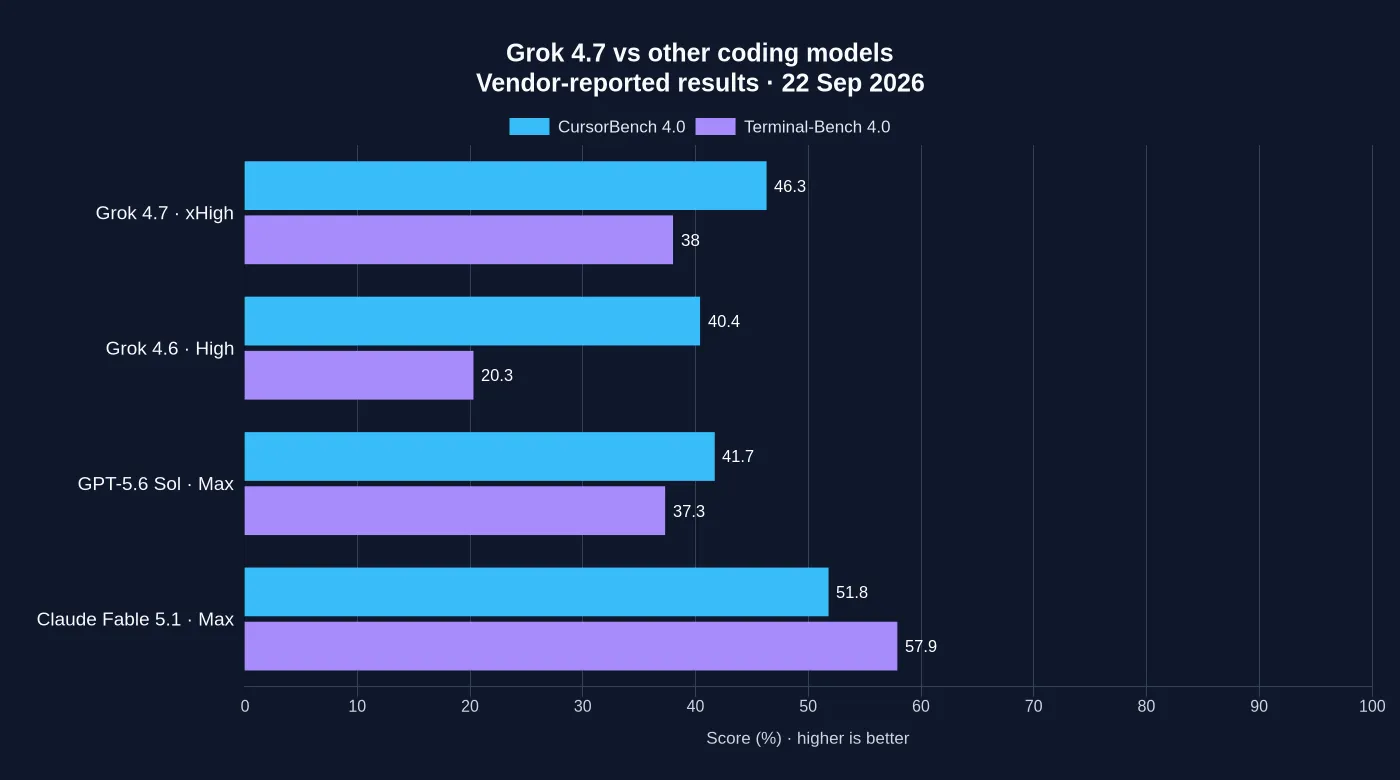
The table below reproduces two coding benchmarks from SpaceXAI’s release announcement. Higher percentages are better. These are vendor-reported results, and the models use different reasoning effort settings.
| Model and reasoning effort | CursorBench 4.0 | Terminal-Bench 4.0 |
|---|---|---|
| Grok 4.7 — xHigh | 46.3 % | 38.0 % |
| Grok 4.6 — High | 40.4 % | 20.3 % |
| GPT-5.6 Sol — Max | 41.7 % | 37.3 % |
| Claude Fable 5.1 — Max | 51.8 % | 57.9 % |
In this selection, Grok 4.7 improves on 4.6 and scores above GPT-5.6 Sol. Fable 5.1 has the highest result on both tests. The table demonstrates progress for Grok, without establishing it as the best model for every coding task.
Source: SpaceXAI — Introducing Grok 4.7
What do the independent tests show?
Artificial Analysis gives Grok 4.7 at xhigh a score of 56 on its Coding Agent Index when running in Grok Build, up from 47 for Grok 4.6 at xhigh. Among models running in their native agent tools, the test places Grok behind Claude Fable 5.1, GPT-6 Astra and Claude Opus 5.
Read this as an evaluation of the combination of model and agent tool. The result does not measure Grok in Cursor. The tools available to the model, and the way the task is run, are part of the test.
Source: Artificial Analysis — Benchmarking Grok 4.7
Google: Gemini 3.8 Flash targets longer workflows
Gemini 3.8 Flash launched on 2 September. Google positions it for software engineering, autonomous agents and multi-step workflows. The documentation specifies up to 1,048,576 input tokens and support for capabilities including tool calls, code execution and structured outputs. The model accepts text, images, video, audio and PDFs, and outputs text.
Source: Google — Gemini 3.8 Flash model specifications
The introductory price is $0.75 per million input tokens and $3.75 per million output tokens. Google says this pricing runs through the end of 2026; the announced rates from 1 January 2027 are $1.50 and $7.50. These are API prices, not the cost of a complete subscription or a finished task.
Gemini 3.8 Flash Cyber launched alongside it for security work. Access is through the Fairwind programme for selected defenders. It should therefore be discussed separately from the Flash model developers can use in everyday workflows.
Source: Google — Gemini 3.8 Flash and Flash Cyber launch
Grok and Gemini: assess quality alongside cost
Artificial Analysis also provides a direct comparison of these models. The table shows its Intelligence Index and weighted average cost per task in that test, as viewed on 22 September. Index points are not percentages and should not be mixed with the coding benchmarks above.
| Model and reasoning effort | Intelligence Index | Cost per test task |
|---|---|---|
| Grok 4.7 — xhigh | 46 | 3.74 USD |
| Grok 4.7 — high | 46 | 2.73 USD |
| Gemini 3.8 Flash — high | 41 | 1.24 USD |
| Gemini 3.8 Flash — medium | 40 | 0.93 USD |
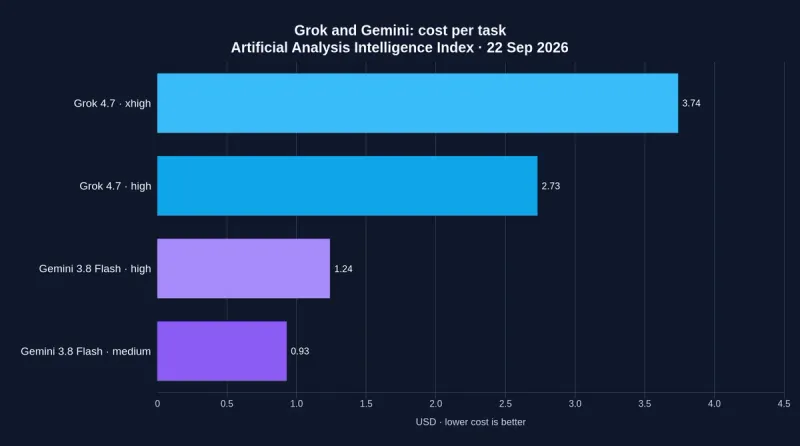
Grok has a higher overall index in this comparison, while Gemini costs less per test task. Equal rounded scores for Grok’s two effort settings do not mean they perform identically on every subtest. The costs apply to this test suite and are not a price guarantee for your project.
Source: Artificial Analysis — Grok 4.7 compared with Gemini 3.8 Flash
Google also has new voice models and an updated agent
Gemini 3.8 Live and Live Extended Thinking arrived on 15 September. They are designed for real-time conversations. Extended Thinking can continue working on more complex tasks in the background while the conversation carries on. This is relevant to voice assistants and customer interactions, but voice benchmark results do not establish which model is best at editing code.
Source: Google — Gemini 3.8 Live and Live Extended Thinking
Google’s API changelog also lists a new Antigravity Agent preview dated 17 September. For existing integrations, changes to tool calls and file editing are worth checking before upgrading. This is an agent update and should be distinguished from the release of the Flash model itself.
Source: Google — Gemini API changelog
How we would compare models on a real project
A useful experiment could be fixing a booking bug: two customers must not be able to reserve the same time slot simultaneously. The task forces the agent to understand existing code, handle concurrent requests and demonstrate that its fix works.
Give each model the same starting point, task and tool access. Use separate copies of the project so one model cannot benefit from the previous model’s changes. Record the model version, reasoning effort, agent tool, time taken and cost.
Then assess whether the solution passes the tests, introduces new bugs, and requires manual corrections. Record abandoned attempts too. A quick demonstration that needs an hour of cleanup may be less valuable than a slower solution you can approve with a few changes.
A prompt you can try
“Investigate how this project handles reservations. Fix the bug that allows two concurrent requests to book the same resource for the same time slot. Follow the project’s existing patterns. Write a test that reproduces the bug, implement the fix and run the relevant tests. Summarise changed files, test results and remaining uncertainty. If you cannot run the tests, explain why. Do not publish or deploy the changes.”
Use the prompt as a starting point and add your project’s actual requirements. For example, clarify whether cancellations, time zones or multiple locations affect what counts as a conflict.
What does this mean for your choice of model?
Our view is that these releases offer more candidates to try, while the task should still guide your choice. Start with a small set of representative problems from your own work. Choose the model and agent tool that deliver reliable results at an acceptable cost with the least rework.
The most useful measure is how much work you actually finish and can trust. Benchmarks help you decide what to test first.